 renovate[bot]
e14db7d79c
This PR contains the following updates: | Package | Change | [Age](https://docs.renovatebot.com/merge-confidence/) | [Confidence](https://docs.renovatebot.com/merge-confidence/) | |---|---|---|---| | [i18next](https://www.i18next.com) ([source](https://redirect.github.com/i18next/i18next)) | [`26.4.7` → `26.5.2`](https://renovatebot.com/diffs/npm/i18next/26.4.7/26.5.2) |  |  | --- ### Release Notes <details> <summary>i18next/i18next (i18next)</summary> ### [`v26.5.2`](https://redirect.github.com/i18next/i18next/blob/HEAD/CHANGELOG.md#2652) [Compare Source](https://redirect.github.com/i18next/i18next/compare/v26.5.1...v26.5.2) - fix(types): on TypeScript 7, a `t()` call with a missing, misspelled or wrongly typed option now reports that option again (`Property 'album' is missing`, `Type 'string' is not assignable to type 'number'`), as TypeScript 5 and 6 do. TypeScript 7 elaborated the error against the default-value signature instead and ended in `'{ count: 3; albm: "Summer"; }' is not assignable to type 'string'`: on a failed call TypeScript explains the last of the equally matching signatures, and TypeScript 7 sorts the 3-element `[key, defaultValue, options?]` last. It is now written as two signatures, `[key, defaultValue]` and `[key, defaultValue, options]`. This affects the default key checks with i18next `{{name}}` messages as well as `parseInterpolation: 'icu'` and `'mf2'`. Which calls compile, their return types and the error positions are unchanged on TypeScript 5.9, 6 and 7. ### [`v26.5.1`](https://redirect.github.com/i18next/i18next/blob/HEAD/CHANGELOG.md#2651) [Compare Source](https://redirect.github.com/i18next/i18next/compare/v26.5.0...v26.5.1) - perf(types): type-checking `t()` calls against a large namespace is no longer quadratic in the number of keys. TypeScript does not cache `keyof` of an object type, and the types rebuilt the union of all keys of a namespace once per key while building the key union, and again in every `t()` call to look up the return type. Both now use a cached key union, and a literal key is looked up directly instead of being intersected with every key. With 5,000 keys in one namespace and one call per key, the check time went from 14.8s to 1.1s (TypeScript 6); with 1,000 keys from 0.75s to 0.27s. Keys, return types and errors are unchanged. - perf(types): the selector API (`enableSelector: true` / `'strict'`) with `context` is no longer quadratic in the size of an object. To decide which keys a context keeps, the types scanned all keys of the object once for every key, also when TypeScript checks the selector with `context` widened to `string`. With 1,000 keys plus one context variant each, a namespace took 18.7s and failed with "Type instantiation is excessively deep and possibly infinite" (TS2589); 2,500 and more ran out of memory. The context variants of an object are now collected once, in one pass over its keys: 1,000 keys check in 0.69s, 5,000 in 3.1s. Long keys (whole sentences with `keySeparator: false`) work as before. Selected values and errors are unchanged. ### [`v26.5.0`](https://redirect.github.com/i18next/i18next/blob/HEAD/CHANGELOG.md#2650) [Compare Source](https://redirect.github.com/i18next/i18next/compare/v26.4.7...v26.5.0) - feat(types): `parseInterpolation: 'icu'` and `parseInterpolation: 'mf2'` type `t()` options from the message's ICU MessageFormat arguments (i18next-icu) or MessageFormat 2 variables (i18next-mf2), so ICU and MF2 users no longer need `parseInterpolation: false` and lose argument checking. Missing, misspelled and wrongly typed arguments fail, and so does leaving out the options for a message with arguments (`t('greeting')`); that error names the missing arguments. Opt-in, default `true` is unchanged. - ICU: `{name}` takes `string | number`, `{n, number}`, `plural` and `selectordinal` take `number`, `{d, date}` and `{t, time}` take `Date`, `select` takes its case keys or any string (for `other`), and arguments nested in cases are required too. `#` and tags are not arguments, apostrophe quoting is read like intl-messageformat does. - MF2: `{$name}` takes `string | number`, a variable annotated with `:number`, `:integer`, `:currency`, `:percent` or `:unit` (inline or through `.input` / `.local`) takes `number`, `:datetime`, `:date` and `:time` take `Date`, `:string` takes `string`, option and markup variables (`minimumFractionDigits=$digits`, `{#link href=$url}`) are required too, `.local` variables are not arguments, and `|quoted literals|` and `\{` escapes are skipped. - `interpolationFormatTypeMap` overrides a type by ICU format or MF2 function name, e.g. `date: Date | number` or a custom `uppercase: string`. - Applies to `t()`, `getFixedT()`, `i18n.t`, key prefixes, namespaces, the selector API and react-i18next's `Trans` `values`. Messages need literal types, as the resources file from i18next-cli's `types` command has them. - Type-check cost with 1,000 messages and one call each: 1.35s instead of 0.86s with `false` (TypeScript 6), 0.5s instead of 0.26s with TypeScript 7. Messages that no call uses cost nothing. - fix(types): with the default (non-strict) key checks, an options object with a missing or misspelled interpolation variable now reports the missing variable (`Property 'name' is missing`) instead of `'{ nmae: string }' is not assignable to type 'string'` from the default-value overload. </details> --- ### Configuration 📅 **Schedule**: (UTC) - Branch creation - At any time (no schedule defined) - Automerge - At any time (no schedule defined) 🚦 **Automerge**: Disabled by config. Please merge this manually once you are satisfied. ♻ **Rebasing**: Whenever PR becomes conflicted, or you tick the rebase/retry checkbox. 🔕 **Ignore**: Close this PR and you won't be reminded about this update again. --- - [ ] <!-- rebase-check -->If you want to rebase/retry this PR, check this box --- This PR was generated by [Mend Renovate](https://mend.io/renovate/). View the [repository job log](https://developer.mend.io/github/authelia/authelia). <!--renovate-debug:eyJjcmVhdGVkSW5WZXIiOiI0NC4xNjQuMSIsInVwZGF0ZWRJblZlciI6IjQ0LjE2NC4xIiwidGFyZ2V0QnJhbmNoIjoibWFzdGVyIiwibGFiZWxzIjpbImRlcGVuZGVuY2llcyIsImphdmFzY3JpcHQiXX0=--> Co-authored-by: renovate[bot] <29139614+renovate[bot]@users.noreply.github.com>



Authelia is an open-source authentication and authorization server providing two-factor authentication and single sign-on (SSO) for your applications via a web portal. It acts as a companion for reverse proxies by allowing, denying, or redirecting requests.
Documentation is available at https://www.authelia.com/.
The following is a simple diagram of the architecture:
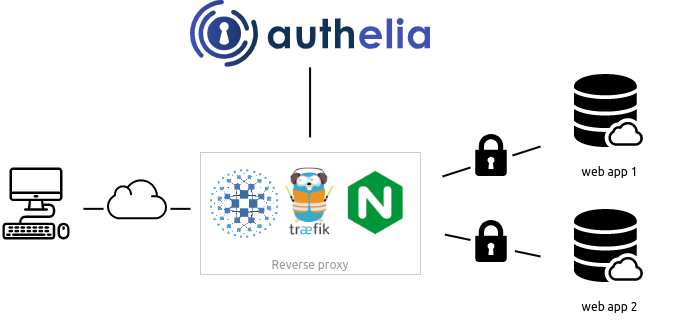
Authelia can be installed as a standalone service from the AUR, APT, FreeBSD Ports, or using a static binary, .deb package, as a container on Docker or Kubernetes.
Deployment can be orchestrated via the Helm Chart (beta) leveraging ingress controllers and ingress configurations.


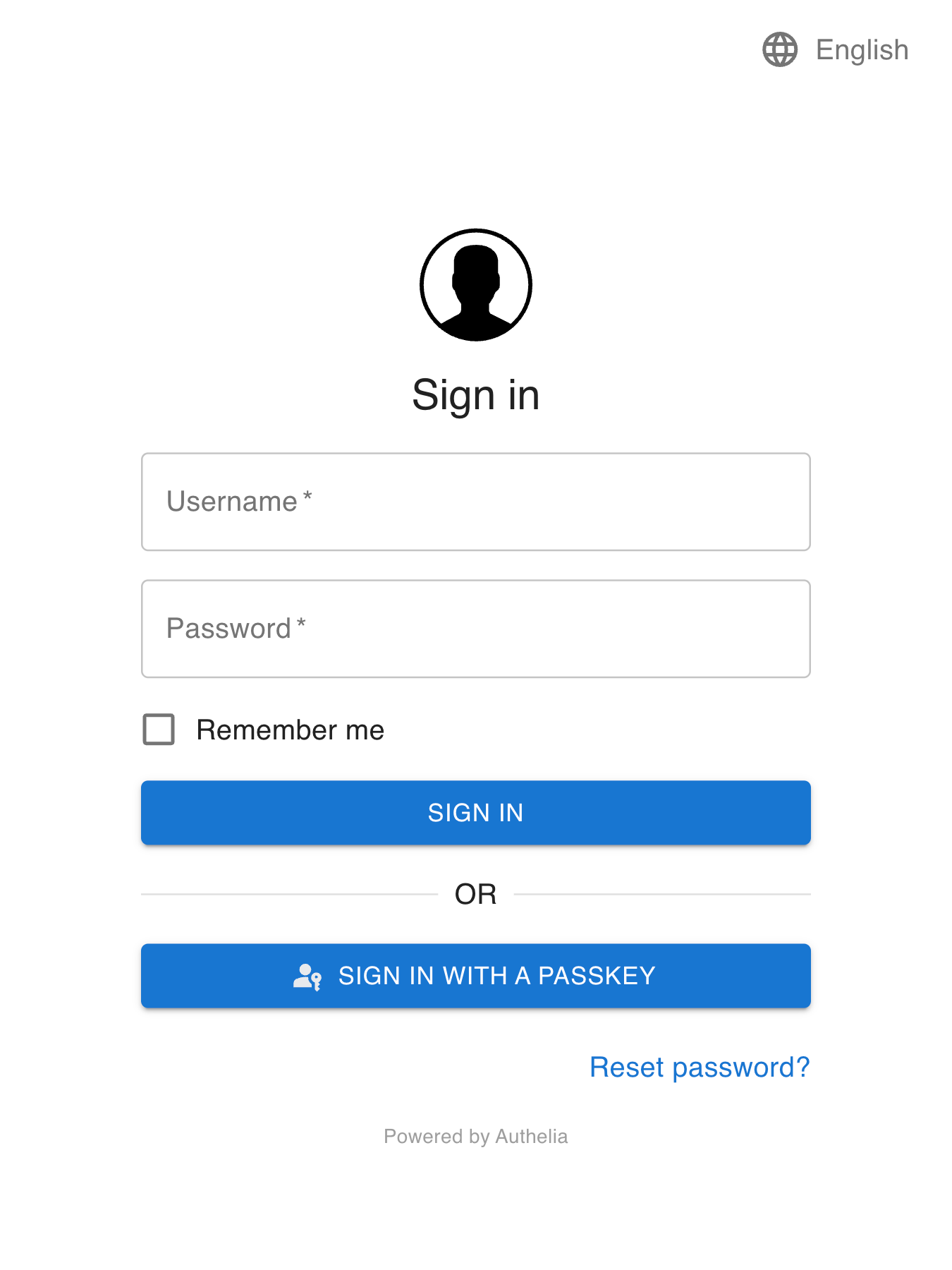
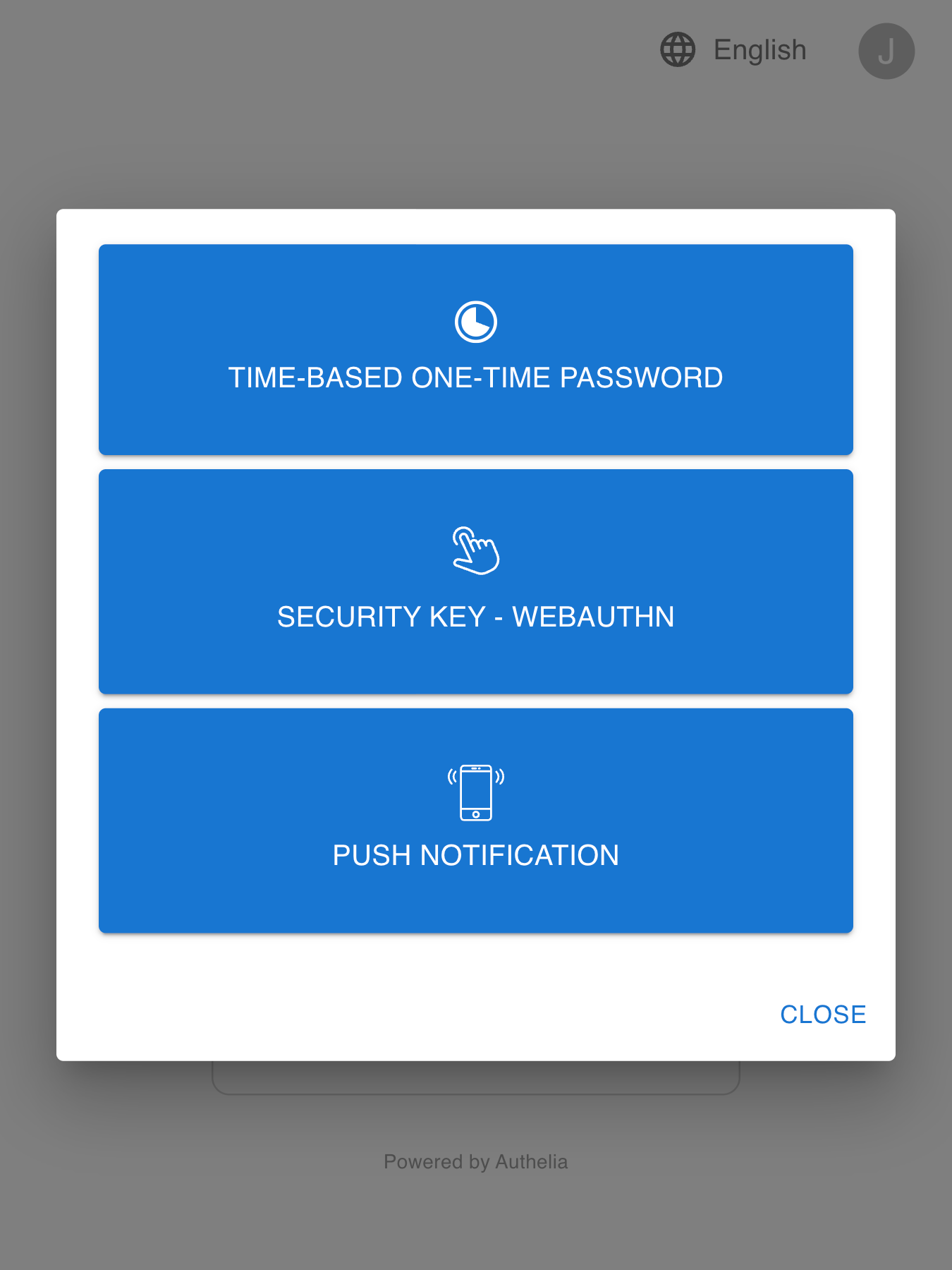
Here is what Authelia's portal looks like:
Features summary
This is a list of the key features of Authelia:
- OpenID Connect 1.0 / OAuth 2.0
- Post-Quantum Cryptography
- Several second factor methods:
- Security Keys that support FIDO2 WebAuthn with devices like a YubiKey.
- Time-based One-Time password with compatible authenticator applications.
- Mobile Push Notifications with Duo.
- Passwordless Authentication via WebAuthn (Passkeys)
- Password reset with identity verification using email confirmation.
- Access restriction after too many invalid authentication attempts.
- Fine-grained access control using rules which match criteria like subdomain, user, user group membership, request uri, request method, and network.
- Choice between one-factor and two-factor policies per-rule.
- Support of basic authentication for endpoints protected by the one-factor policy.
- Highly available using a remote database and Redis as a highly available KV store.
- Compatible with Traefik out of the box using the ForwardAuth middleware.
- Curated configuration from LinuxServer via their SWAG container as well as a guide.
- Compatible with Caddy using the forward_auth directive.
- Kubernetes Support:
- Compatible with several Kubernetes Ingress Controllers and Gateways:
- Beta support for installing via Helm using our Charts.
For more details take a look at the Overview.
If you want to know more about the roadmap, follow Roadmap.
OpenID Connect 1.0 / OAuth 2.0
Authelia is OpenID Certified™ to the Basic OP / Implicit OP / Hybrid OP / Form Post OP / Config OP profiles of the OpenID Connect™ protocol. While this offering is still effectively on the roadmap as a beta it's very comprehensive and well implemented already, also allowing us comprehensive certification. Read more about the OpenID Certified™ status of Authelia in the OpenID Connect 1.0 Integration Guide.

Proxy support
Authelia works in combination with nginx, Traefik, Caddy, Skipper, Envoy, or HAProxy.





Getting Started
See the Get Started Guide or one of the curated examples below.
docker compose
The docker compose bundles act as a starting point for anyone wanting to see Authelia in action. You will have to
customize them to your needs as they come with self-signed certificates.
Local
The Local compose bundle is intended to test Authelia without worrying about configuration. It's meant to be used for scenarios where the server is not be exposed to the internet. Domains will be defined in the local hosts file and self-signed certificates will be utilized.
Lite
The Lite compose bundle is intended for scenarios where the server will be exposed to the internet, domains and DNS will need to be setup accordingly and certificates will be generated through LetsEncrypt. The Lite element refers to minimal external dependencies; File based user storage, SQLite based configuration storage. In this configuration, the service will not scale well.
Deployment
Now that you have tested Authelia and you want to try it out in your own infrastructure, you can learn how to deploy and use it with Deployment. This guide will show you how to deploy it on bare metal as well as on Kubernetes.
Security
Authelia takes security very seriously. If you discover a vulnerability in Authelia, please see our Security Policy.
For more information about security related matters, please read the documentation.
Contact Options
Several contact options exist for our community, the primary one being Matrix. These are in addition to GitHub issues for creating a new issue.
Matrix
Community members are invited to join the Matrix Space which includes both the Support Room and the Contributing Room.
- The core team members are identified as administrators in the Space and individual Rooms.
- All channels are linked to Discord.
Discord
Community members are invited to join the Discord Server.
- The core team members are identified by the CORE TEAM role in Discord.
- The #support and #contributing channels are linked to Matrix.
You can contact the core team by email via team@authelia.com. Please note the security@authelia.com is also available but is strictly reserved for security related matters.
Breaking changes
Since Authelia is still under active development, it is subject to breaking changes. It's recommended to pin a version
tag instead of using the latest tag and reading the release notes
before upgrading. This is where you will find information about breaking changes and what you should do to overcome
said changes.
Why Open Source?
You might wonder why Authelia is open source while it adds a great deal of security and user experience to your infrastructure at zero cost. It is open source because we firmly believe that security should be available for all to benefit in the face of the battlefield which is the Internet, with near zero effort.
Additionally, keeping the code open source is a way to leave it auditable by anyone who is willing to contribute. This way, you can be confident that the product remains secure and does not act maliciously.
It's important to keep in mind Authelia is not directly exposed on the Internet (your reverse proxies are) however, it's still the control plane for your internal security so take care of it!
Contribute
If you want to contribute to Authelia, please read our contribution guidelines.
Authelia exists thanks to all the people who contribute so don't be shy, come chat with us on either Matrix or Discord and start contributing too.
Thanks goes to these 96 wonderful people (emoji key)




































































📖 Documentation Overlords
and these 226 wonderful people who keep the documentation worth reading


This project follows the all-contributors specification. Contributions of any kind welcome!
Sponsors
Help Wanted: We are actively looking for sponsorship to obtain either a code security audit, penetration testing, or other audits related to improving the security of Authelia.
Any company can become a sponsor by donating or providing any benefit to the project or the team helping improve Authelia.
JetBrains
Thank you to  JetBrains
for providing us with free licenses to their great tools.
 IDEA
 GoLand
 WebStorm
Buildkite
Our pipeline agents rely on the Buildkite CI platform. This is an amazing product which allows us to use our own infrastructure to orchestrate complex and secure pipelines.
Open Collective
Backers
Thank you to all our backers! 🙏 Become a backer and help us
sustain our community. The money we currently receive is dedicated to fund a security audit, and potentially in the
future introducing a bug bounty program to give us as many
eyes as we can to detect potential vulnerabilities.

Sponsorship
Companies contributing to Authelia via Open Collective will have a special mention below. Become a sponsor.


License
Authelia is licensed under the Apache 2.0 license. The terms of the license are detailed in LICENSE.
